Mesh count
Bold, heavy-deposit work and fine halftones need different openings. Ink particle size and viscosity matter too.
Pre-burned screens in Chicago
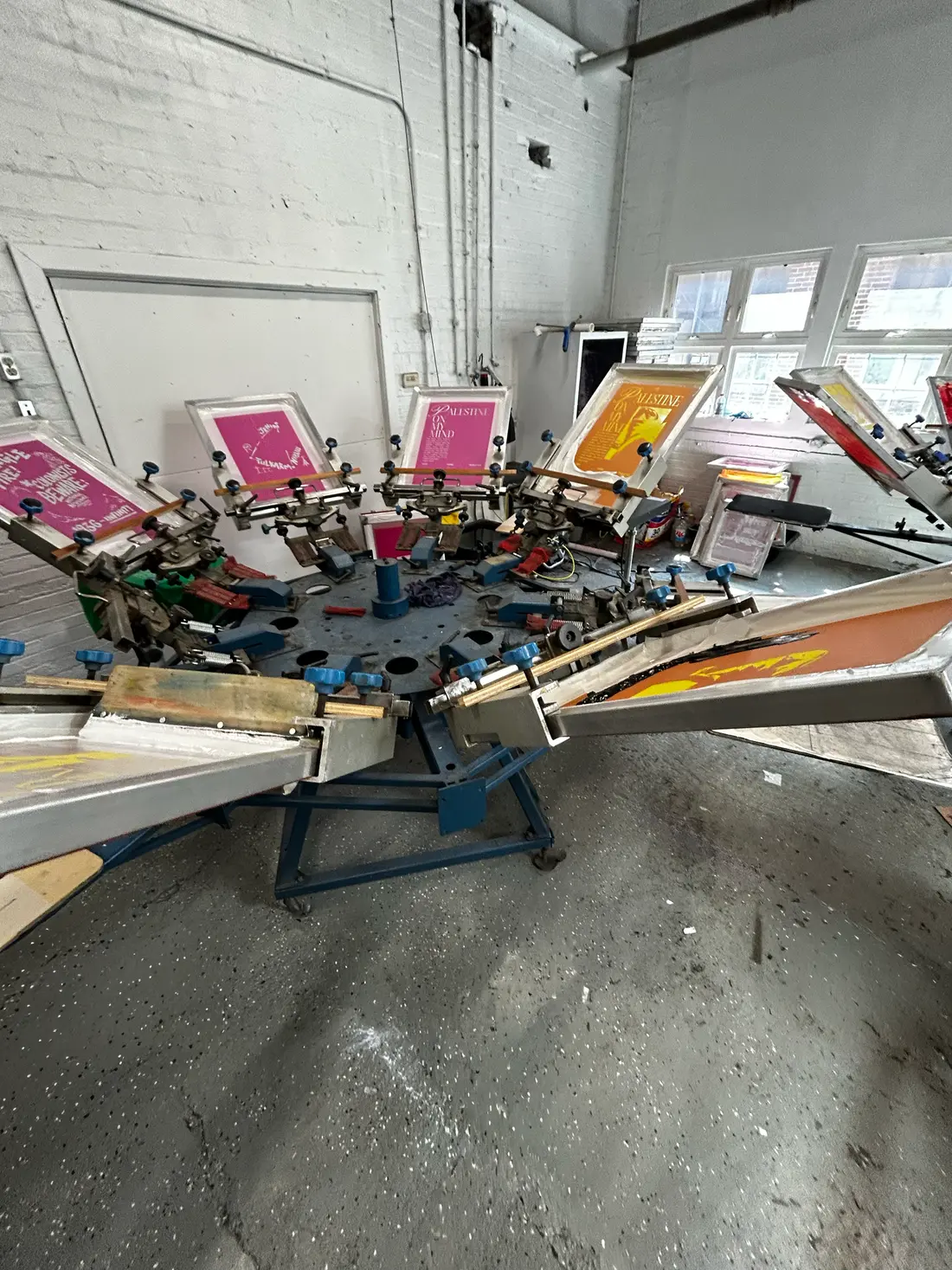
Skip coating and exposure without giving up a deliberate setup. We preflight the artwork, recommend mesh around the image and ink, expose the stencil, wash it out, and prepare the screen for your press.
Select your screens, upload each design and pay online when your screen options are available.
 CAOS CREATES / CHICAGO
Ready for your press
Mesh count is not a quality score. Lower mesh generally allows a heavier ink deposit, while higher mesh can hold finer detail with less deposit. The right choice depends on line weight, halftones, substrate, ink, opacity, and the press conditions you can control.
We review the file at final size, confirm orientation and printable area, and prepare the stencil around its intended use. You receive a screen with the image exposed and washed out; registration, ink selection, print technique, and curing remain part of your own press setup.
Inside the work
You provide the artwork, final size, ink type, substrate, screen dimensions, press type, and any registration requirements.
We inspect resolution, line weight, halftones, transparency, orientation, and whether the image fits the safe printable area.
Detail and deposit are balanced around the artwork and intended ink rather than choosing one mesh for every job.
The screen is coated, dried, and exposed using a controlled stencil workflow.
The image is opened, checked for complete detail, and inspected for pinholes or stencil issues.
The finished screen is dried and identified so you can move into registration and printing at your shop.
Expert production choices
A stencil can expose cleanly and still be wrong for the job. These choices determine how it behaves on press.
Bold, heavy-deposit work and fine halftones need different openings. Ink particle size and viscosity matter too.
Lines and gaps that are too fine for the selected mesh or stencil can break, fill in, or print inconsistently.
Dot size, angle, mesh, film quality, and exposure must work together to hold tonal detail.
The emulsion-side orientation and press setup must be confirmed so the print reads correctly on the substrate.
Frame dimensions are not the same as usable image area; room is needed for ink movement and press clearance.
Multi-color work needs consistent placement, films, and registration references across every screen in the set.
Artwork guide
The stencil can only hold the information present in the source. Clean, high-contrast art gives the most predictable result.
Where it shines
Before production
Artwork, mesh, ink and your press setup all affect the screen. Review these details before choosing your configuration.
The screen is coated with emulsion, exposed with your artwork, washed out, dried, and prepared as a stencil. You handle registration, ink, printing, and curing.
It depends on detail, ink, substrate, and desired deposit. Lower mesh generally deposits more ink; higher mesh supports finer detail with a thinner deposit.
Yes, when the source art, dot frequency, mesh, film, and exposure are compatible. Send the original art and intended print details for review.
We can review it, but low-resolution compressed images may need paid cleanup or rebuilding. Final-size vector or high-resolution black artwork is more dependable.
No. We can maintain alignment across a multi-screen set, but you must register the screens to your own press and platens.
You need a compatible press or hinge setup, ink, squeegee, substrate, registration method, test material, and the correct flash or curing equipment for your ink.
Built for your project
Select a frame and mesh, specify the print size, and upload each design. Need separations or help with your setup? Talk to CAOS before paying.
ORDER NOW DESIGN / MAKE / DELIVER